

The Complete Guide to Yin Yang
Yin and Yang are the two complementary poles that describe every rhythm in nature: rest and motion, receiving and giving, dark and light. They aren't opposites. They are two halves of one whole, constantly flowing into each other. Understanding Yin Yang is the first step into Chinese philosophy, Traditional Chinese Medicine, and Eastern astrology.
What Is Yin Yang?
The concept of Yin Yang (阴阳) originated in Chinese philosophy more than 3,000 years ago and is the foundation upon which the Five Elements, your Energy Chart, and Traditional Chinese Medicine are built. The earliest written references appear in the I Ching, the Book of Changes, where Yin and Yang are depicted as broken and solid lines.
At its simplest, Yin Yang describes the observation that everything in the universe contains its opposite, and that reality moves through cycles of polarity. Day becomes night; summer becomes winter; breath in becomes breath out. Neither pole can exist without the other, and neither is "better." The goal in Eastern philosophy is not to pick one, but to recognize when the moment calls for which, and to allow the natural flow between them.
This is why Yin Yang is not a moral framework. Yin is not "bad" and Yang is not "good." Rest is not weaker than action; silence is not less valuable than speech. Every person contains both, and a balanced life moves fluidly between them.
The Taijitu Symbol Explained
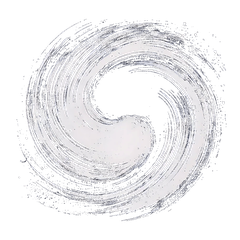
The familiar black-and-white swirl you know as the "yin yang symbol" is formally called the Taijitu (太極圖), meaning "diagram of the supreme ultimate." Every element of its design encodes a philosophical principle.
The Two Halves
Black (Yin) and white (Yang) divide the circle equally, symbolizing that the two forces are always present in balanced proportion across the universe as a whole.
The S-Curve
The boundary between them is not a straight line but a curve, signaling that Yin and Yang are never static. They flow into each other continuously.
The Dots
A white dot within the black, and a black dot within the white, shows that each pole contains the seed of its opposite. Nothing is purely one thing.
The Circle
The enclosing circle represents the Tao, the whole, the undivided source from which the polarity emerges and into which it dissolves.
Qualities of Yin & Yang
Yin and Yang are not things, they are qualities that describe how energy behaves. Here are the classical associations you'll see across every Chinese discipline.
- Expressive, outward, active
- Warm, hot, bright, dry
- Day, summer, sun, sky
- Motion, speech, creation
- Male archetype (not gender)
- Function, movement, transformation
- The organ surface (skin, muscle)
- Fast, hard, obvious
Notice that these are relative, Yin and Yang only exist in relation to each other. Your body is Yang compared to a rock; it's Yin compared to the sun. The same moment is Yang compared to an hour ago; Yin compared to an hour from now.
The 10 Yin Yang × Five Element Signatures
Yin Yang doesn't stop at two poles. When you cross the Yin Yang axis with the Five Element axis, you get the foundational ten energetic signatures of Eastern astrology and TCM. These are the ten Heavenly Stems (天干) of your Energy Chart, and the ten constitutional patterns that show up in every TCM diagnosis.


Tap any signature to see how it shows up in birth pillars (60 Jiazi), TCM constitutional patterns, and personality archetypes. Or view all 60 Jiazi pillars for the complete breakdown of each Yin Yang × Element pairing.
Yin Yang in Daily Life
You are already navigating Yin Yang without naming it. When you feel burned out and crave a bath and silence, Yin is calling. When you feel flat and want to get up and do something, Yang is calling. The skill is to recognize the call and answer it in kind, instead of pushing through with the opposite energy.
Most modern exhaustion is a Yang excess problem: too much screen, too much output, too much caffeine, too little sleep. The corrective is not "more productivity hacks" (more Yang), it's Yin: rest, nourishing food, warmth, being received rather than always producing. Conversely, depression and stagnation often signal Yin excess, and the corrective is gentle Yang: sunlight, walking, connection, small accomplished tasks.
Over a day, week, season, and lifetime, you're meant to cycle between both. Resisting that cycle is where most modern wellness problems begin.
Yin Yang in Relationships
One of the most useful applications of Yin Yang is in understanding partnership. In any relationship, romantic, professional, familial, one person tends to carry more Yang in a given moment (the initiator, the speaker, the doer), and the other more Yin (the receiver, the listener, the holder of space).
Healthy relationships alternate these roles. One person isn't always the Yang. When the dynamic gets stuck, one person always initiating, always caring, always speaking, resentment builds. Rebalancing comes from the Yang person practicing receiving, and the Yin person practicing initiating, in small deliberate ways.
Yin Yang in Traditional Chinese Medicine
In Traditional Chinese Medicine, nearly every diagnosis begins with a single question: is this pattern Yin or Yang? Signs of Yang excess include fever, redness, restlessness, rapid pulse, loud voice, insomnia. Signs of Yin excess (or Yang deficiency) include coldness, pallor, fatigue, slow pulse, soft voice, excessive sleep.
Treatment then works to rebalance. Warming herbs and moxibustion add Yang; cooling herbs and nourishing foods build Yin. Acupuncture points are chosen along Yin or Yang meridians depending on what needs to move. Even the concept of qi (life force) is divided into Yin qi (structural) and Yang qi (functional).
This is why TCM practitioners observe things modern medicine often overlooks, tongue coating, pulse quality, voice, skin temperature. These are the Yin Yang signals of what's happening underneath.
Frequently Asked Questions
What does yin yang mean?
Is Yin bad and Yang good?
Is Yin female and Yang male?
How do I know if I am Yin or Yang?
What is Yin Yang balance?
How does Yin Yang relate to the Five Elements?
Is Yin Yang religious?
Can Yin Yang help with stress and burnout?
Where this fits in Chinese astrology
The first foundation: every part of Chinese astrology — your sign, your chart, your timing — is built on the balance of these two poles.
See Your Personal Yin Yang Balance
Your Energy Chart reveals whether you lean Yin or Yang, and how to work with that balance. Get your free reading.